Sunday, September 19, 2010

Few tips for Advanced Algorithms


If you are doing “Introduction to Algorithms and Data Structures” or “Advanced Algorithms”, there video lectures will be very useful.
http://ocw.mit.edu/courses/electrical-engineering-and-computer-science/6-046j-introduction-to-algorithms-sma-5503-fall-2005/video-lectures/
OR
http://www.youtube.com/results?search_type=search_playlists&search_query=mit%27s+introduction+to+algorithms&page=1


Apart from it , I find the data structures like splay trees, B trees are very useful.
http://www.youtube.com/watch?v=G5QIXywcJlY

And this is a java applet you can try out with different data structures.
http://people.ksp.sk/~kuko/bak/big/

To simulate Max-Flow Min-Cut algorithm
http://www.cse.yorku.ca/~aaw/Wang/MaxFlowStart.htm AND http://optlab-server.sce.carleton.ca/POAnimations2007/MaxFlow.html

Wednesday, September 15, 2010

Hike to Thotupola Kanda


Few months back, I and few friends of mine went on a hike to Thotupola kanda, which is the third highest mountain in Sri Lanka.
It was kind of interesting, but had to walk almost 34km throughout the day.
We started the journey from Colombo, around 8pm so we can reach the starting point in the next morning.
My friend; Rohan Wickramasinghe the most travelholic guy in the team had reserved 2nd class tickets. But unfortunately he had reserved them for the next date. So finally we decided to travel on 3rd class and move on.
3rd class service was not that good for a long journey like that. Anyway it was quite an experience.

On the way to Ohiya...

When the train moves towards up country; it needs an extra engine to be coupled. So at Rambukkana and Pattipola, the train is stopped for several minutes more to couple and decouple the extra engine.

Coupling and De-coupling...
After pattipola, we reached to Ohiya; one of the highest villege in te Badulla district in SL and high 1774m above sea level.


In Ohiya; there was a small shop and the shop owner rented one room of his home for us. We rested there for a while and started our hike.
Initially it was sunny and windy. We could see the far beyond the horizons.


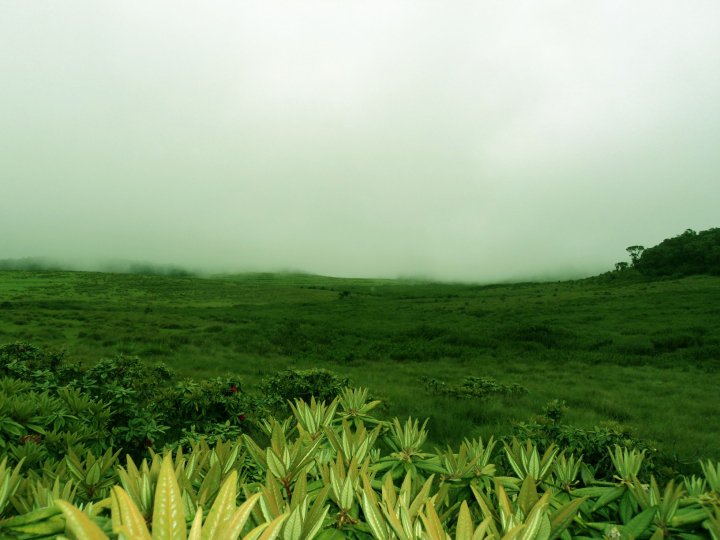
But the sunny part left us and suddenly it became so foggy.

On the way to Horton plains...

After few hours we reached Horton Plains.


It’s a cloud forest filled up with fresh and raw green with beautiful flowers.


Also there are many species which are endemic to the region. But we couldn’t spent much of time for them.
We walked over the green a lot of time until we reach the junction which leads to Thotupola Kanda.


Then we started to climb up our target. By the time it was rainy + windy + foggy.


When we reached the peak of the mountain; it was as foggy as we couldn’t see much around.


After having lunch around 2pm we climbed-down the mountain and slowly walked towards the Pattipola railway which is the highest railway station in Sri Lanka. Our plan was to catch a train from Pattipola and to go to Ohiya.


Fortunately or unfortunately when we reached there, train had already left 10 min ago and there were no trains for the day. So we had to walk from Pattipola to Ohiya (around 8km) via the railway which was never planned.


There is a place called “Summit level” which is highest pot of Sri Lanka and which is 1898m high above sea level.

At summit level...

By the time it almost was getting dark. But the craziest issue was to pass the railway tunnels which are dark and filled with bats every time. If a train came when we were half on the way through the tunnel, we just had to lie down on the muddy ground and stay away from the rail tracks as much as possible. But the gap between the train and the tunnel was so thin. So we had no clue what we should do if a train came.
Believe me; this was really dangerous and we didn’t have many torches or even people didn’t live around. Later I got to know that due to security reasons passing the tunnel by foot is prohibited.

Inside the "Tunnel 18"...

On the way we passed through around 3 tunnels and 2 bridges. The three tunnels are different from each other and one of them is the 3rd longest rail way tunnel in Sri Lanka; which is called Tunnel 18.

I'm at the Tunnel 18.

Tunnel 18th is very especial one because every time it's very dark. Lot of bat lives in there. This tunnel is a bending one. Tunnel was made by 1919 and after some times it was repaired. On the tunnel there is a mountain called Nasdanda mountain. Near this tunnel there is another two Railway tunnels. One of them is very short and bend and other one is very long and direct not bend one.
Main important thing of Pattipola tunnel 18thTunnel is both sides of this tunnel is different. This tunnel divides Badulla and Nuwaraeliya districts, Border of Welimada and Nuwaraeliya Electorates, dry Zone and Wet Zone, Green forest zone and highest west gap zone.
When you through this tunnel from Ohiya side you feel somewhat hot and you can see the sunshine and see clear air. After you move Pattipola side you feel different than that. Now you feel very cool and you may be able to see sunshine and you can see the mist come and covered every places in there. However if you can feel changing whether zones like that, you're very lucky.


Even passing a bridge was tricky in a darker environment. After a one and half hour walk we reached to Ohiya. The time was around 7pm.


So we stayed the night at Ohiya and came back to Colombo via train in the next morning.

Friday, May 21, 2010

Mooshabaya Feature Demonstration

This is my final year project-Mooshabaya feature demonstration webcast. This demo contains most of the project features. Hey, this is a voiceless webcast ;), and hope to add the voice soon.

Sunday, April 11, 2010

Career Opportunities in Information Communication Technology(ICT)


This blog post is for folks who are looking for career opportunities in Sri Lankan ICT (Information and Communication Technology) sector. I referred the presentation slides by Mr. Samantha Senarathne, visiting lecturer from Department of Computer Science and Engineering, University of Moratuwa. The presentation was created for the ICT awareness seminar series which was organized by my batch mates last month.

Not only in Sri Lanka but also around the globe there is a huge demand for ICT related academia. But still the supply of skilled IT graduates is not sufficient to cope with industrial demand in Sri Lanka. So there is a huge competition for jobs as well.

If you want to be successful at what you do there is a universal truth for the success on any thing. That is "Decide upon Your True Dreams and Goals". So if your true dreams and goals don't deal with ICT, the final outcome won't be that you expected.

These are few reasons to choose ICT field
  • Good job opportunities
  • Demand across the world
  • Higher economic benefits
  • Different career development paths
  • Traveling opportunities to other countries
If you are really good at what you do, you'll have the demand across the globe.

There are many paths you can consider
  • Software Engineering
  • Network Engineering
  • System security
  • Project Management
  • Quality assurance and Testing
  • System administration
  • Wed site development
  • Database administration
  • Technical support
  • Client management
  • IT consultancy

There are seamless opportunities in this field across the globe. But considering our country, above have significant opportunities. For more information just Google them, you'll find plenty of stuff. Here are some details specific to our country on choosing an IT degree.

Engineering fields require a strong mathematical background. So most of the times if you choose physical science stream for your A/L examination, it'll be a strong foundation to go forward. Then if you pass A/L well and eligible to enter to a University for Engineering you can choose Computer Engineering degrees offered by Moratuwa, Peradeniya and Ruhuna Universities.
Or there are other degrees like Physical Science and Computer Science from Universities like Colombo, Peradeniya, Kalaniya, Sabaragamuwa, Sri jayawardanapura, Rajarata and Eastern etc.
As well there are IT degrees offered by University of Moratuwa. But apart from your A/L qualifications you need to pass another aptitude test as well.
There are some other external IT degrees offered by Open University (Bachelor of Software Engineering), Moratuwa University (Bachelor of Information Technology) and Colombo University (Bachelor of Information Technology).
As well there are private institutes like SLIIT which offers degrees related to IT and some other areas. But you need to pay for those.
As well there are several private institutes which offers IT degrees with the support of overseas Universities. Some of them are Informatics (IIT), APIIT, IDM, ESoft etc.
Or you can go overseas like Australia, Malaysia, Singapore, USA, UK, and India and study there as well.

How you can start
  1. Initial level jobs
  2. Professional Training
  3. IT degrees
You may not have specific educational qualifications or training. But with a small training you can apply for professions like computer programmer, web site developer, graphic designer etc. But essentially you need to have some skills related to those. If you are capable of self learning and to grab something quickly that will be a little challenge.
But if you want to go to a higher level, educational qualifications and experiences are highly recommended. So never stop learn.
There are certifications related to this sector like Microsoft certifications, Sun certifications, Cisco certifications etc.
There are diplomas offered by BCS, ACS, NIBM, HND, IDM, ESoft etc. You also should consider the quality and the recognition of the diploma.
I have mentioned about IT degrees on a previous section.

Requirements
  • Dedication
  • Self-confidence
  • Commitment
  • Positive attitude
  • English language skills
  • Good communication and soft skills
  • (Money - only if to have a degree, diploma or certification from a private institute)
Hope you had some idea regarding the career opportunities in SL ICT sector. Good luck!

    Saturday, March 27, 2010

    You and Social networks


    Do you spend more and more time these days on one or more social networking sites like Facebook, Buzz and Twitter? Yep most of us are. But most of us don't think of the hackers, crackers, identity thieves, phishers, cyberstalkers whatever you call them also out there and have turned their attention to the big social sites. The threats are also getting increased in different faces. But most of us don't give much thought to how to defend themselves.

    Most of the popular social networks like Facebook and Twitter etc. have been become attractive targets (honey pots) as the huge number of potential victims and the numbers are increasing exponentially. For Facebook it's around 400 million and I don't know exact figures for twitter.:)

    Normally in each week we here at least one major attack against big social media sites. like New Twitter Phishing Attack: “You’re On Here?” [WARNING] or like Latest Facebook Scam: Phishers Hit Up "Friends" for Cash.

    The main issue here is unknown parities are potential of getting direct access to your personal or sensitive information stored in your computer. They do not need to physically access to your information as these social networks are run on distributed machines.
    Let's take an example from a particular social network. Some third party Facebook applications pull out private information to work correctly. These apps even can pull out your friend's info as well. So the potential victim is not only you but your friends as well. Most of those applications are like photo of the day, or some statements, jokes etc. First it asks for some thing like this.


    If you allow it, then the risk is all on yours. I do not want you to get the wrong idea, Facebook applications for the most part are safe. Just like anything else on the Internet they can be exploited so it pays to be careful.

    If a person that has evil intentions makes a Facebook app, they can now target all of the people who have allowed the application in their Facebook ecosystem and target them for identity theft. As those applications run different from the Facebook main servers, it's nearly impossible to validate the logic of the third party application. So the hackers may use the existing security wholes in the Facebook developer platform and attack the users. As well those social media sites also try to cover those security wholes as much as possible.

    I feel user's common sense and the correct attitude towards the social networks are essential as well the technology can help to mitigate the potential risk.

    Here are few tips any one can follow
    • Secure your passwords
    • Don't click here and there - The short URLs like "http://bit.ly/9OrLf4" which forward you to a page when you click. Problem is, there's no way to tell where those short URLs really lead without clicking on them.
    • Use a up-to-date browser
    • Read and judge the messages carefully - Sometimes the the site it-self provide some messages if there are potential threats to the user. But if the user does not read the message carefully the risk is all on the user.

    Saturday, March 13, 2010

    ICT in Sinhala/Tamil or English


    Today I was preparing few presentation notes on ICT subject for O/L , A/L students and those for an upcoming ICT awareness seminar series to be held in some schools in rural areas, Sri Lanka. So obviously the content is supposed to be in Sinhala and Tamil medium. When I went through the Sinhala teachers' manual, all most all the content have been explained well, and the editors have done a great job. As well they have taken a great effort to use our own terms instead of English terms.

    But what I felt was whether we will able to generate our own knowledge base at least a glossary in our own mother tongue, for a subject like ICT. For subjects like Chemistry, Physics which are more theoretical the case is different as we have our own scientific terms which were generated a long time back.

    But for a subject like ICT, the field is changing rapidly, so the existing information get updated rapidly and new information, technologies pop-up like crazy. So it's quite impossible to generate our own terms, with the present pace of change.
    It's a good move if the students are motivated to use English terms themselves rather force them to remember the Sinhala terms. Because after they leave the school, those Sinhala terms are not gonna be valid for them anymore.